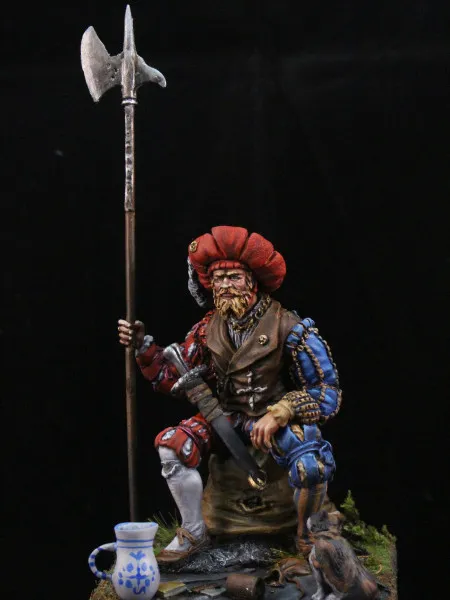
Historical · 90 mm
Lansquenet
The lansquenets were mercenaries, most often "German", operating from the fifteenth to the end of the sixteenth century. They served in most of the European armies of the time and gained a great reputation in the first half of the sixteenth century for their efficiency but also their brutality.
From the German Landsknecht, attested since 1480, Knecht "valet" indicating a servitude to the "employer" and Land "country" or more certainly in this case "countryside" marking the country origin of these mercenaries who did not come from the mountains, unlike the Swiss pikemen. From 1500, we note the alteration Lanzknecht influenced by Lanze "spear, pike", the term Landsknecht is still found in modern German in the sense of "mercenary" (Söldner).
As the Swiss troops had repeatedly demonstrated that the best of the cavalry was powerless against infantrymen equipped with pikes up to six metres long, many rulers decided to create units on the model of these Swiss Reisläufer. In Bavaria, one of the main mercenary leaders in the service of the emperor was Georg von Frundsberg. In Florence, for example, there is the Loggia dei Lanzi, so named because of the presence of German mercenaries stationed nearby. This was the beginning of the glory era of the lansquenets, of which Maximilian I of Habsburg (1459-1519), nicknamed the "father of the lansquenets", may have marked the apogee.
Source: Wikipedia
- Type
- Figure
- Category
- Historical
- Genre
- Foot figure
- Scale
- 90 mm
- Techniques
- Oil
- Status
- Collection
- Brand
- Tartar Miniatures